Theory about GHG emissions
from reservoirs
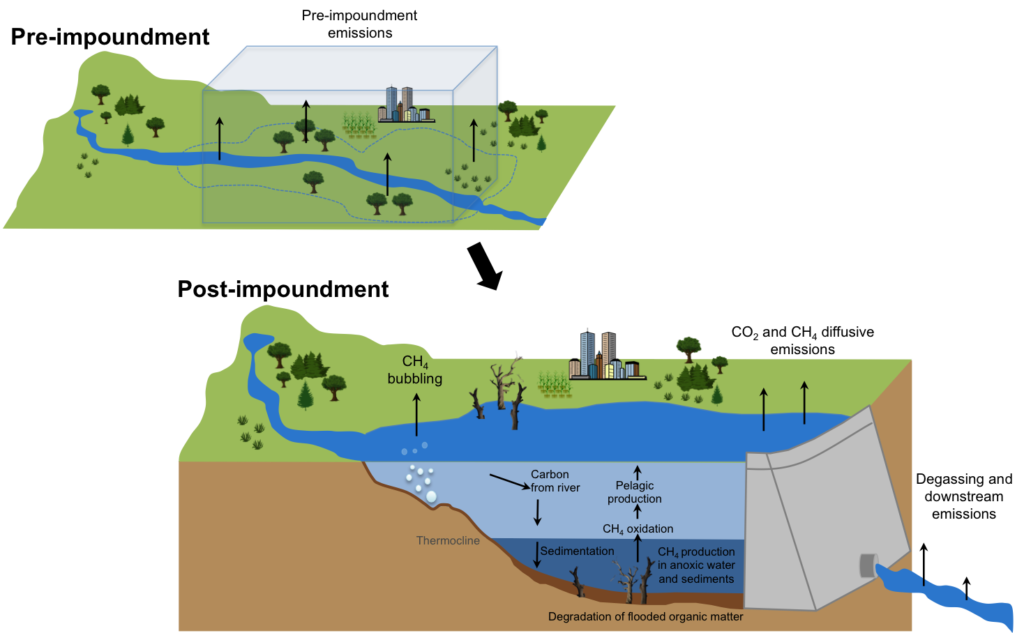
The creation of reservoirs to provide services such as hydropower, flood control, irrigation, water supply requires flooding land upstream of dams, which leads to the rapid decomposition of organic matter contained in soils. This decomposition can lead to the release of important amounts of greenhouse gases (GHGs) in the first few years after flooding. Over time, these emissions decrease and gradually stabilize as the reservoir ages. The main GHGs produced and emitted are methane (CH4) and carbon dioxide (CO2).
Today, methane dominates total global reservoir emissions, and its relative contribution compared with carbon dioxide is expected to continue increasing. This shift occurs partly because carbon dioxide emissions decline more rapidly over time, while some new reservoirs, especially those expected to be built in warmer climates, may involve higher methane emissions depending on site characteristics.
Methane is produced by microbes that decompose newly flooded organic matter in oxygen‑free zones, such as deep reservoir layers and sediments. Unlike carbon dioxide that declines more rapidly over time, methane emissions tend to show a smaller initial peak but remain relatively constant for longer periods. Although methane has a higher global warming potential, it stays in the atmosphere for a shorter time, meaning its climate effect is more intense but over a shorter duration.
Emissions from reservoirs are dynamic and can be emitted through different pathways. CO2 and CH4 can both be emitted from the surface of the reservoir to the atmosphere via diffusive flux. As an hydrophobic gas, methane can accumulate in the sediment of the reservoir and be released to the atmosphere as bubbles (bubbling emissions). Another pathway specific to reservoirs is called degassing and is the sudden release of gas at the exit of the dam after going through the intake and turbine.
One‑third of methane emissions from reservoirs result from degassing. This occurs when water drawn from deep reservoir layers—where methane concentrations are high—is released downstream, causing the methane to escape into the atmosphere.
The encouraging news is that reservoir design and operational changes can significantly reduce methane emissions. For example, drawing water from closer to the surface can greatly reduce or even eliminate methane degassing.
Highly inspired from our 2024 blog on reservoirs emissions: https://www.hydropower.org/blog/reservoir-emissions-from-1900-2060-how-does-the-timeline-look