
G-res Tool
The G-res Tool is an intuitive online platform designed to estimate GHG emissions from reservoirs without requiring on-site measurements. It supports companies and researchers in calculating and reporting the net greenhouse gas emissions of a reservoir, offering investors, regulators, and local communities greater assurance regarding its climate impact and carbon footprint.
Developed over more than ten years, the tool emerged from a collaborative project involving the International Hydropower Association and the UNESCO Chair in Global Environmental Change. Its scientific foundation was created with scientists from the University of Quebec at Montreal (UQAM), the Norwegian Foundation for Scientific and Industrial Research (SINTEF), and the Natural Resources Institute of Finland (LUKE), with additional support from the World Bank.
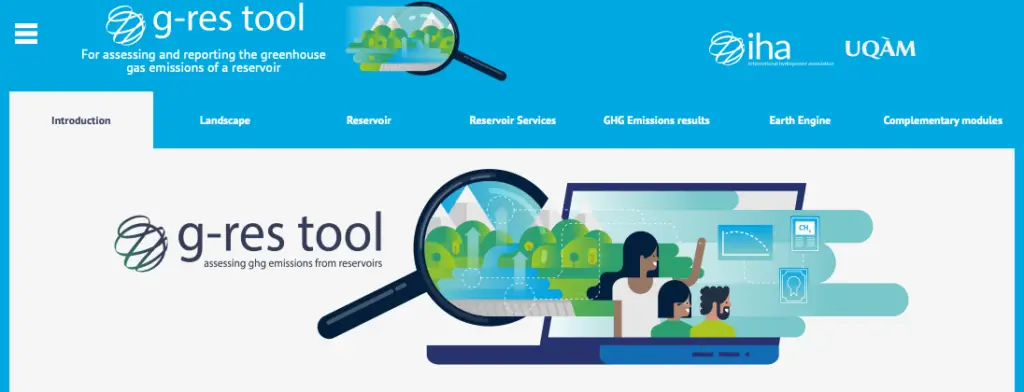
As one of the original developers of the G-res Tool, we offer several specialized services:
G-res tool certified training
We provide a three-days training course that guide individuals and organizations in using the G-res Tool effectively and interpreting results with confidence.
This training contains three main modules:
- Scientific introduction to the tool
- Step-by-step tutorial on how to use it
- Case scenarios and results analysis
It is offered 2-3 times a year virtually as a blend of live sessions and homework preparing case studies or watching pre-recorded videos.
Introduction to GHG emissions from reservoirs
We offer an introductory conference designed for companies and public organizations seeking to better understand GHG emissions from reservoirs. This session is tailored to participants with little to no prior knowledge of the topic and provides a clear, science-based overview of key concepts and challenges.
The conference covers:
- Scientific introduction
- Transformation following the creation of a reservoir: temperature, shape, flow, nutrients, GHG emissions
- Main GHG emission pathways: Diffusive emissions, bubbling emissions, degassing emissions
- Less known emissions pathways
- Methods available for reporting GHG emissions: Field, Emissions factors, Modelling (different models including description of the G-res Tool), Remote sensing
- Uncertainty of GHG emissions
- Case study
- Mitigation of GHG emissions
Our goal is to provide participants with the foundational knowledge needed to engage with this issue confidently and to support informed decision-making in operational and policy contexts.
Assessments and Validation:
Our team also offers support in preparing G-res tool assessment report for your organization or validating G-res Tool results from your own assessment to ensure transparent and trustworthy reporting.